Her name
Hathor is the Greek form of the Egyptian name Ḥwt-Ḥr, usually translated “House of Horus.” It can be read as the sky-house in which the falcon-god Horus dwells.
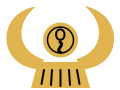 HetHeru
Chamber I
Goddess of love, music, joy and the sky; mother, nurse and welcomer of the dead. This page gathers what Egyptian sources and scholars say about her, and marks anything less certain.
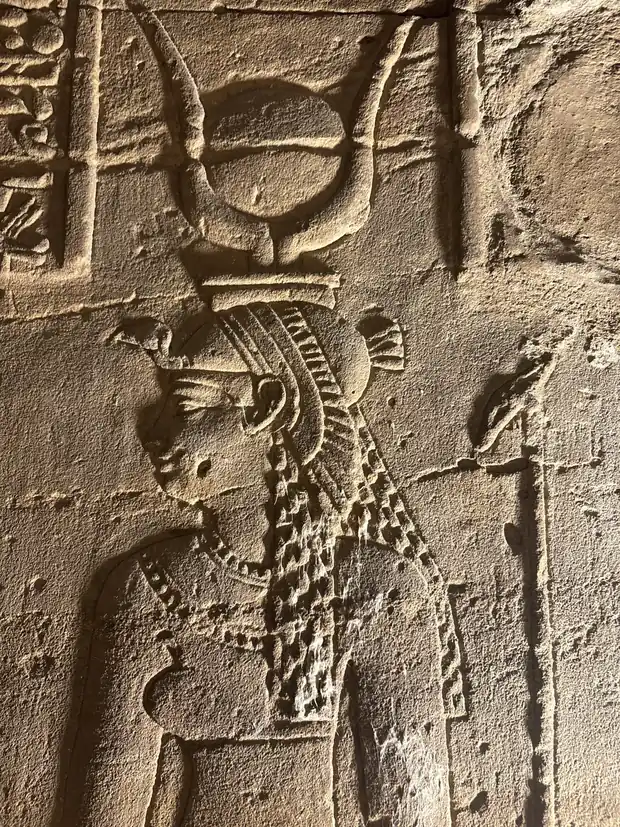
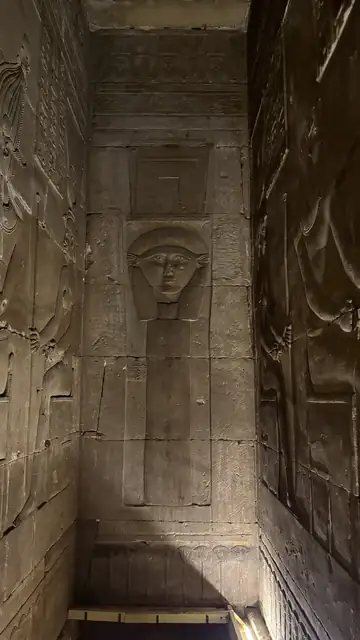
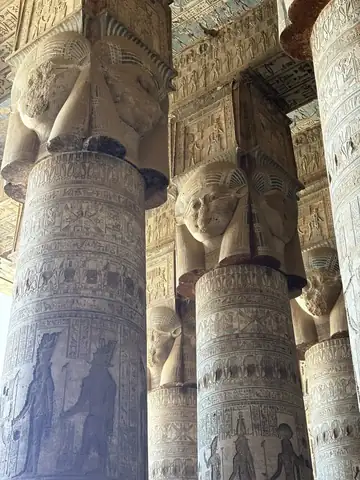
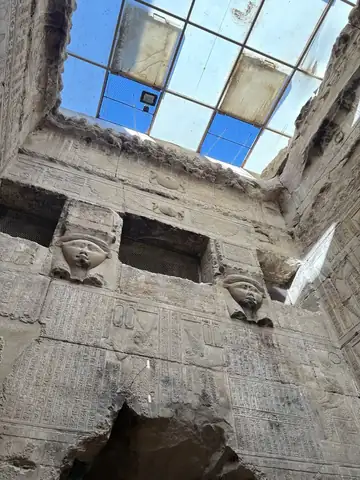
The photographs are from the site owner’s visit; see the Dendera Visit page for the full set.
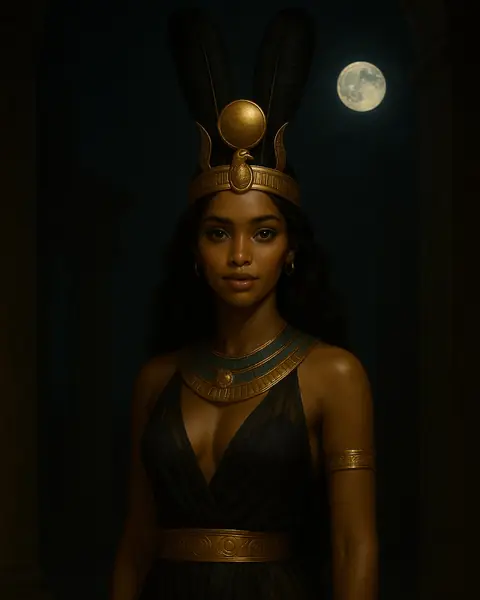
Most facts here are firmly in the ancient record and carry no label. Where scholars read the evidence differently, or the point is uncertain, the fact is marked: Scholarly interpretation Uncertain
Hathor is the Greek form of the Egyptian name Ḥwt-Ḥr, usually translated “House of Horus.” It can be read as the sky-house in which the falcon-god Horus dwells.
Love, beauty, music, dance, joy, motherhood and the sky. She was also tied to foreign lands and to the riches that came from them, such as turquoise, copper and incense.
As a cow; as a woman with cow horns holding a sun disk; and sometimes as a woman with cow ears. Her name-glyph and her face also appear on the sistrum and on “Hathor-column” capitals.
Her best-known cult centre was Dendera in Upper Egypt. The temple standing today dates mainly to the Ptolemaic and early Roman periods (first century BCE – first century CE), on a site used for far longer.
At Serabit el-Khadim in the Sinai, Egyptian mining expeditions built a temple to Hathor as patron of the turquoise mines.
In the myth often called the Destruction of Mankind, the Eye of Ra goes out as a fierce goddess and is pacified. In that story the Eye appears as Hathor and as the lioness Sekhmet.
Especially at Thebes, Hathor was the goddess of the western necropolis and was shown receiving the dead into the West.
A cow-form Hathor suckles the king in reliefs, for example in the Hathor shrine at Deir el-Bahari. This expresses his divine legitimacy.
The sistrum, a rattle shaken in ritual, was a sacred instrument closely tied to Hathor. Isis, who took over many of Hathor’s symbols from the New Kingdom, is also shown with one.
Her link with Byblos, the port on the coast of modern Lebanon, goes back to the Old Kingdom, long before the Greco-Roman period. An alabaster offering plate of King Pepy I (Sixth Dynasty) found at Byblos names “Hathor, Mistress of Dendera,” and a scribe statuette of the same time reads “Hathor, Mistress of Dendera, who lives in Byblos.”
The explicit title “Lady of Byblos” is attested in Middle Kingdom Coffin Texts. Scholars read it as Egypt identifying Hathor with Byblos’s own goddess, Baalat Gebal. Egyptian texts stop linking the two after the New Kingdom, as Isis grew more prominent. This blending is a separate matter from the later Hathor and Isis blending.
A cylinder seal of King Khafre (Fourth Dynasty) found at Byblos bears Hathor’s name without any title. Some scholars take it as an earlier sign of the link. This is not settled.
The Punt reliefs in Hatshepsut’s temple at Deir el-Bahari say the expedition’s goods were sent “for Hathor, Mistress of Punt.” Punt was a source of incense and other luxury goods. It is believed to lie on the Red Sea coast of north-east Africa, and its exact location is debated.
Hathor’s cult reached Nubia with Egyptian expeditions and New Kingdom building there. A rock-cut chapel to “Hathor of Ibshek” stood at Faras, a Hathor temple stood at Mirgissa, and Ramesses II built the Small Temple at Abu Simbel for Hathor and Queen Nefertari. Who first built the Faras chapel is uncertain.
In later periods seven Hathors appear as fate-givers at a child’s birth. This is attested in Egyptian literature such as the Tale of the Doomed Prince.
In the Greco-Roman period Hathor and Isis were increasingly blended, and the Greeks identified Hathor with Aphrodite. This is separate from Hathor’s much older link with Byblos.
Cow-faced heads on the Narmer Palette (around 3100 BCE) are often linked with Hathor or with the related goddess Bat. Scholars disagree, so treat it as an open question.
Epithets are the titles by which Hathor was addressed. Translations vary between scholars, so the English wording below is one common rendering.
Her role as protector and welcomer of the dead in the western necropolis, especially at Thebes.
Often rendered “Mistress of the West.”
Patroness of the turquoise mines and of the Sinai expeditions; the title is attested at Serabit el-Khadim.
Also “Mistress of Turquoise.”
Her principal cult title, tying her to the temple city of Dendera.
Regional titles like this one name her local cult.
Daughter and fierce agent of the sun god, sent out to punish and then calmed.
Shared with other goddesses, such as Sekhmet, Tefnut and Mut.
Names her radiance and her link to gold, the “flesh of the gods.”
Egyptian nbw, “golden.” Often used as a bare epithet.
Hathor as a tree-goddess who gives shade and food and refreshes the dead. At Memphis she is “Lady of the Southern Sycamore.”
The sycamore fig was sacred to her.
Her sky aspect. She is the heavens in which the sun is born and rises.
Also used for other goddesses, such as Isis and Nut.
Hathor was worshipped at the port of Byblos as a patron of Egypt’s trade there. The link goes back to the Old Kingdom; the explicit title is attested in Middle Kingdom Coffin Texts.
Her identity with the local goddess Baalat Gebal is a scholarly interpretation.
Named “Hathor, Mistress of Punt” in the inscriptions of Hatshepsut’s Punt expedition at Deir el-Bahari. Punt was a source of incense.
Punt’s exact location is debated.
This page is a plain-language summary and a starting point, not a substitute for primary sources. Spellings and translations differ between scholars. If you quote a title, check it against a published translation or the temple inscription itself. The owner may add personal reflections and interpretations elsewhere on the site, always labelled as such.