1 Horned figures: Khepri / solar power inside the horns
Observed
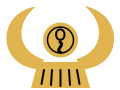
Two horned anthropomorphic figures were isolated. One horn-space appears to contain paired scarab-like forms; another contains a circular solar form with descending rays/lines.
Reading (the site owner, as discussed with Violet)
The site owner reads the first through Khepri/scarab symbolism and the second as a solar/Aten-like charging of the horns. The important visual point is that the horn interiors are not empty: distinct sacred/astronomical emblems occupy them. Rather than treating the figures as generic horned beings, the interior horn imagery should be compared as deliberate variants.
Status Uncertain / working inference Reading, not confirmed
2 The three 'capes' / severe celestial figures
Observed
A small group of unusual figures appears with broad triangular or mantle-like forms around the body, visually unlike many neighboring figures.
Reading (the site owner, as discussed with Violet)
The site owner describes them as cape-wearing, serious, almost villainous in posture. That modern analogy is useful as morphology: their silhouettes genuinely separate them from nearby bodies. Working question: are these garments, wings, astronomical attributes, or another conventional device?
Status Uncertain / working inference
3 Star-and-stripe panels: the 'American / Confederate flag' resemblance
Observed
One small rectangular panel contains a vertical field with repeated star shapes and alternating blue/white-looking bands. Nearby, another rectangular form contains a prominent diagonal X with internal striping.
Reading (the site owner, as discussed with Violet)
Placed beside one another, the site owner immediately saw a visual resemblance to the later United States flag and Confederate battle-flag vocabulary. This is recorded as a striking visual analogy, not a claim of historical descent. The productive question is why stars, stripes, grids and diagonal-cross geometry appear in neighboring celestial sign groups.
Status Uncertain / working inference
4 Feminine Eye
Observed
An eye-form appears unusually eyelashed or cosmetically emphasized compared with the simplified eye signs around it.
Reading (the site owner, as discussed with Violet)
The site owner reads the eye as conspicuously feminine. That is worth preserving: Egyptian divine eyes can be personified and gendered, and Dendera's Hathoric environment makes feminine eye imagery especially interesting. Exact identity remains open.
Status Uncertain / working inference
5 Monumental Eye + Seven Hathors + solar barque
Observed
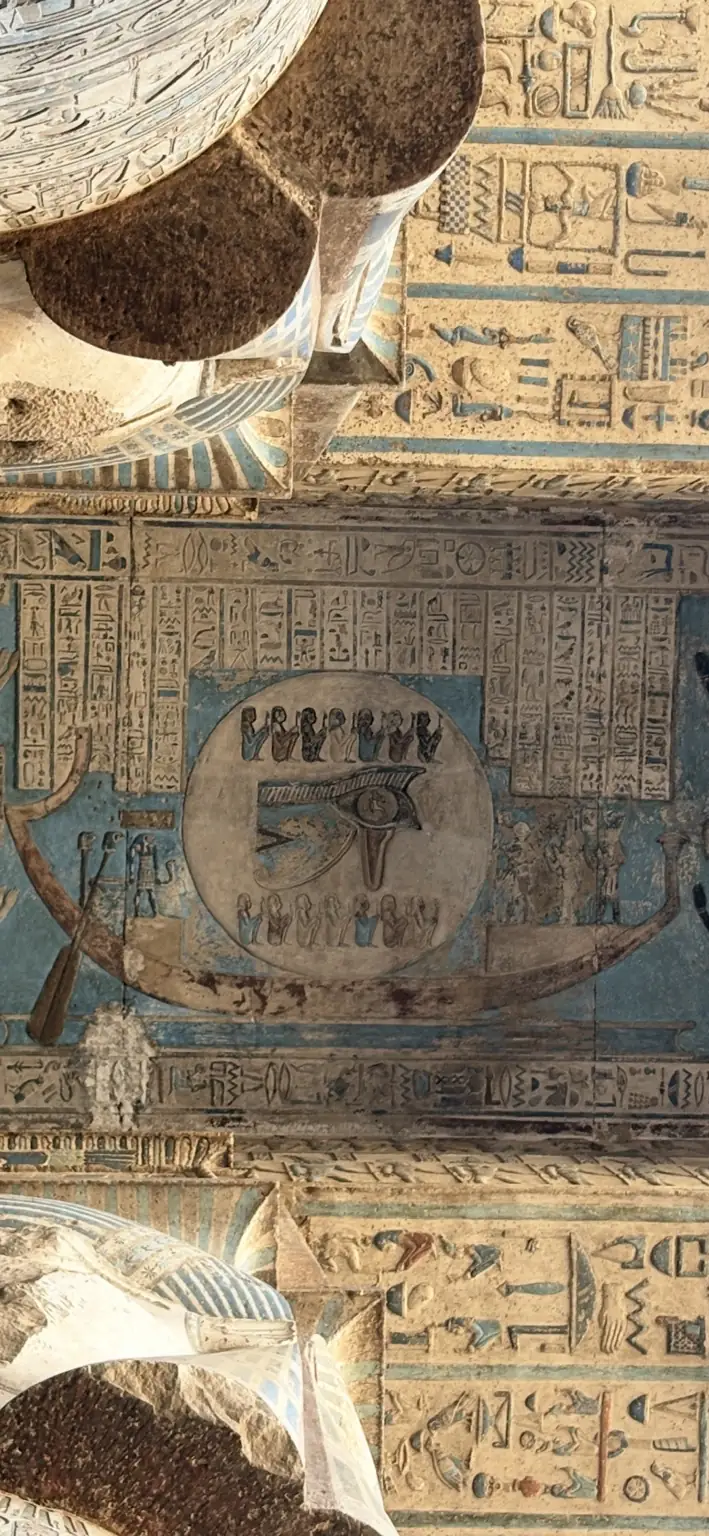
A monumental Eye dominates a circular field. Rows of small divine figures appear above and below it, and the wider view clearly places the entire ensemble within a large boat/barque composition.
Reading (the site owner, as discussed with Violet)
The site owner identifies the surrounding group with the Seven Hathors and notes a Horus figure associated with the Eye. The wider photograph establishes that 'boat' is not a speculative visual metaphor here: barques are an explicit compositional structure. This supports taking smaller eye/boat juxtapositions seriously as part of the ceiling's repeated visual grammar of sacred powers in transit.
Status Uncertain / working inference Reading, not confirmed
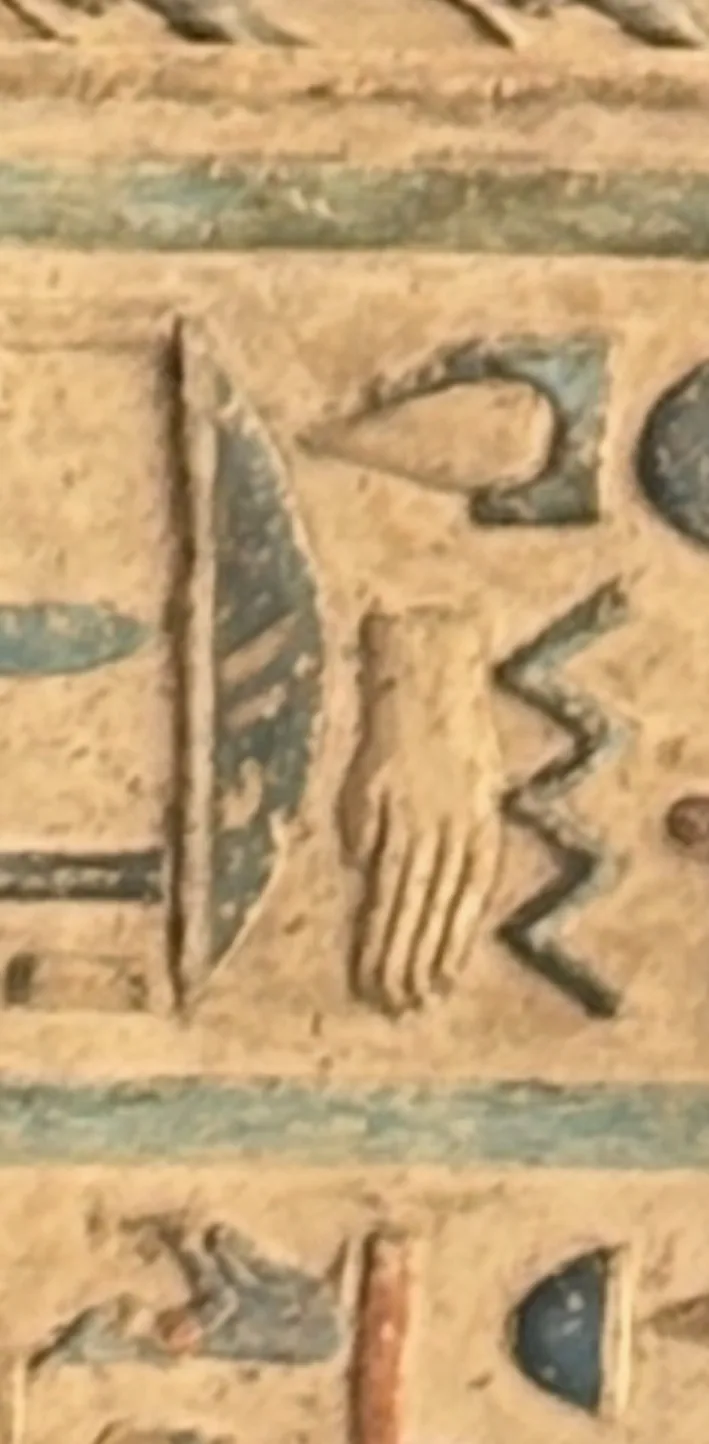
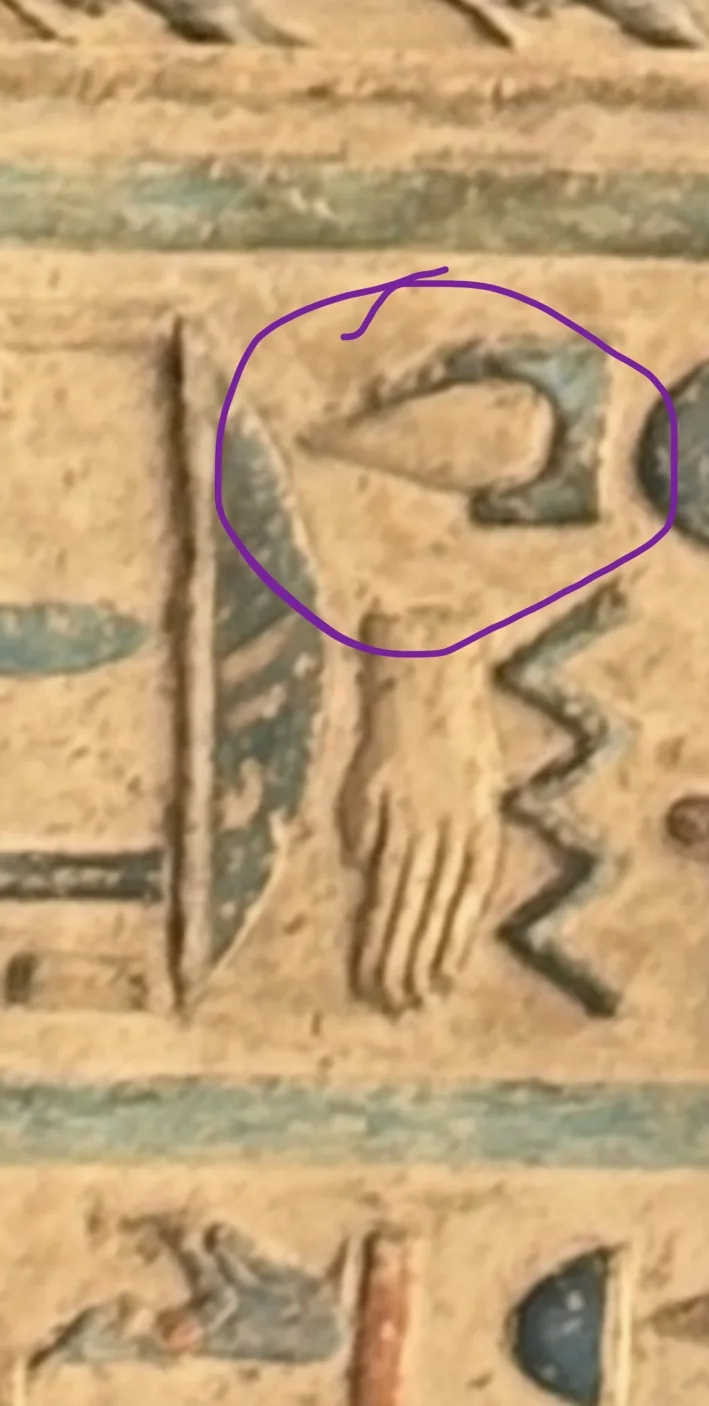
6 One eye facing the 'double-eye boat / smile'
Observed
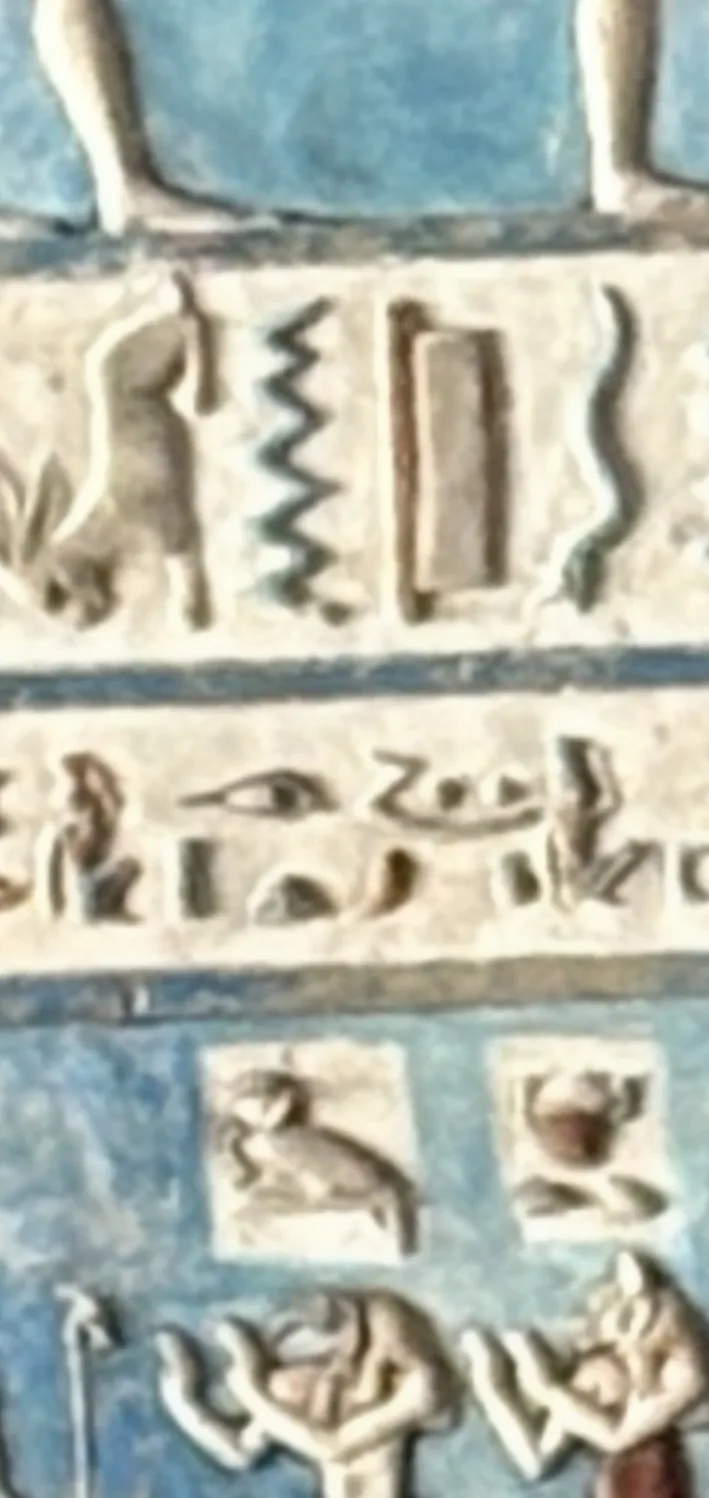
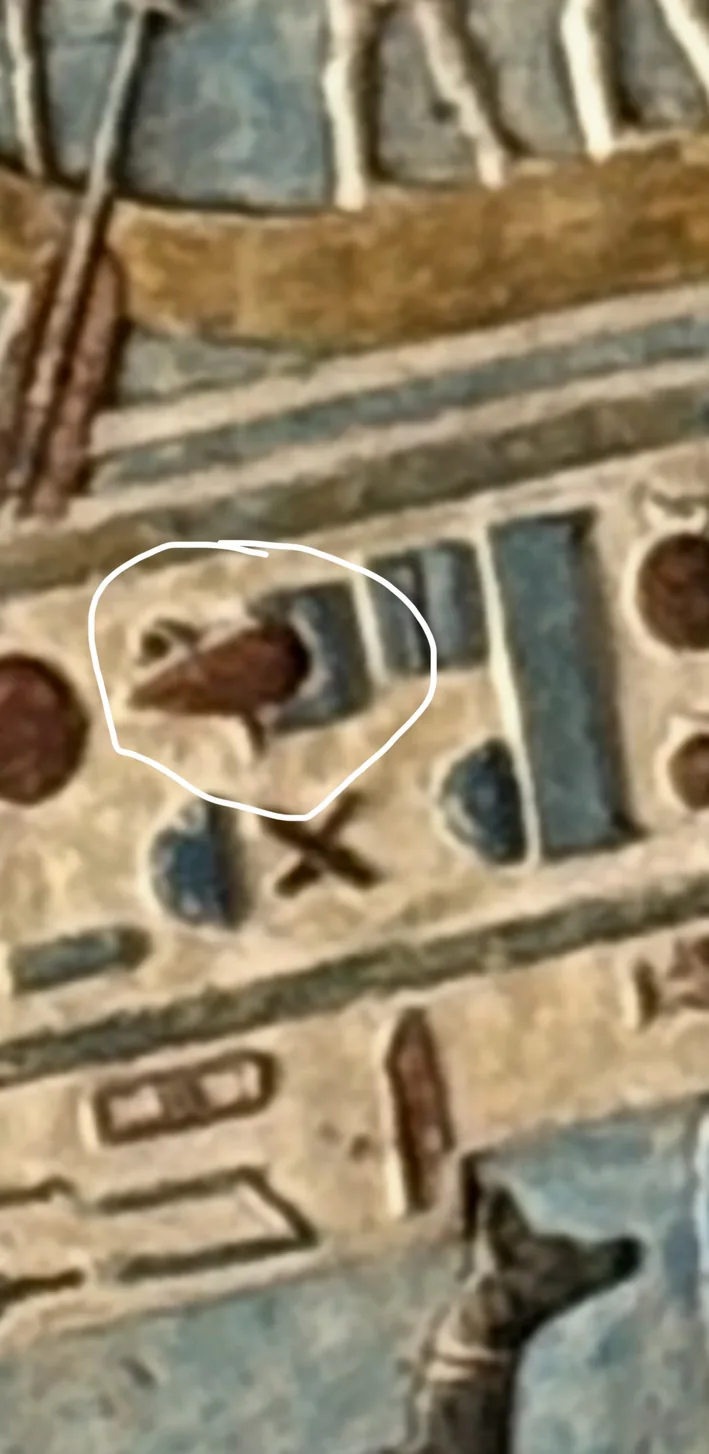
A single wedjat-like eye faces a neighboring compact sign group containing two rounded eye-like forms above an upturned curved base.
Reading (the site owner, as discussed with Violet)
The site owner reads the neighbor as two eyes in a boat and, simultaneously, as one of the 'smiley faces of Dendera.' The larger barque scenes strengthen the boat association as a visual inference. Exact hieroglyphic identification can remain open without denying the visible eye-to-double-eye/boat relationship.
Status Uncertain / working inference
7 Heh and Hauhet – infinity pair
Observed
A paired divine arrangement was recognized by comparison with reference imagery of Heh and Hauhet; elsewhere Heh imagery appears in the column program.
Reading (the site owner, as discussed with Violet)
The site owner specifically corrected the name to H-A-U-H-E-T and reads the pairing through infinity/eternity. This matters because the ceiling's astronomical program repeatedly moves between measurable celestial ordering and enormous temporal/cosmic concepts.
Status Uncertain / working inference Reading, not confirmed
8 Hathor beside Taweret
Observed
A Hathoric female figure appears in close visual proximity to Taweret-like imagery within the ceiling program.
Reading (the site owner, as discussed with Violet)
The site owner flags the pairing rather than treating each deity as an isolated icon. Adjacency may be compositional rather than narrative, but the cluster is worth mapping because Dendera's visual theology often works through constellations of divine functions.
Status Uncertain / working inference Reading, not confirmed
9 Ear sequences: lizard → human ears → cow ear; human ear → hare / Wenut
Observed
The site owner isolated repeated ear-like forms: a sequence visually read as lizard, human ears and a bovine/cow ear; elsewhere a human-ear pair appears beside a hare-like form.
Reading (the site owner, as discussed with Violet)
The hare association prompted comparison with Wenut/Wenet, a hare-associated goddess who can also appear with Hathoric attributes. The key discovery is the repeated adjacency of hearing/ear morphology with animal forms. This deserves side-by-side sign comparison rather than dismissal as random glyph proximity.
Status Uncertain / working inference Reading, not confirmed
10 Djed pillar + Hathor horns
Observed
A Djed-like vertical form appears visually enclosed by, or conjoined with, a pair of upward-curving horn forms.
Reading (the site owner, as discussed with Violet)
The site owner calls it the 'Djed Pillar Hathor Horn' collaboration and immediately saw it as shirt-worthy iconography. Symbolically, stability/endurance (Djed) meeting Hathoric horn geometry is a powerful visual conjunction even before the exact sign-group grammar is settled.
Status Uncertain / working inference
11 Standing serpent and three overlaying serpents
Observed
One serpent is shown upright/vertical; another motif contains three serpents crossing or overlaying a central upright form.
Reading (the site owner, as discussed with Violet)
The site owner noticed posture as meaningful variation rather than treating every snake as interchangeable. The overlay may encode plurality, direction, binding, protection, astronomical structure or a composite sign. The atlas keeps these possibilities open and prioritizes comparing repeated serpent morphologies across the ceiling.
Status Uncertain / working inference
12 Serpents at false-door / threshold-like forms
Observed
Repeated upright serpents occur beside rectangular architectural or doorway-like forms. The site owner compared these with museum material explaining Egyptian false doors as ritual portals for the deceased.
Reading (the site owner, as discussed with Violet)
The visual reading is 'snakes guarding the doors': serpents stationed at thresholds as protective or boundary powers. The museum false-door tablet supports the site owner's understanding of the portal concept, while the specific Dendera forms still deserve formal identification. The protective-threshold inference is strong enough to investigate, not something to suppress.
Status Uncertain / working inference
13 Heart above Ma'at's feather
Observed
A red, heart-shaped form appears vertically above/near a feather-like sign within a bounded scene.
Reading (the site owner, as discussed with Violet)
The site owner immediately read this through the weighing of the heart against Ma'at's feather. The resemblance is compelling at the iconographic level. Whether this exact register depicts the canonical judgment scene remains to be established, but 'heart + feather' is too specific a conjunction to ignore.
Status Uncertain / working inference Reading, not confirmed
14 Nekhbet as protective bird + Horus-child + 'baby-rattle' sistrum
Observed
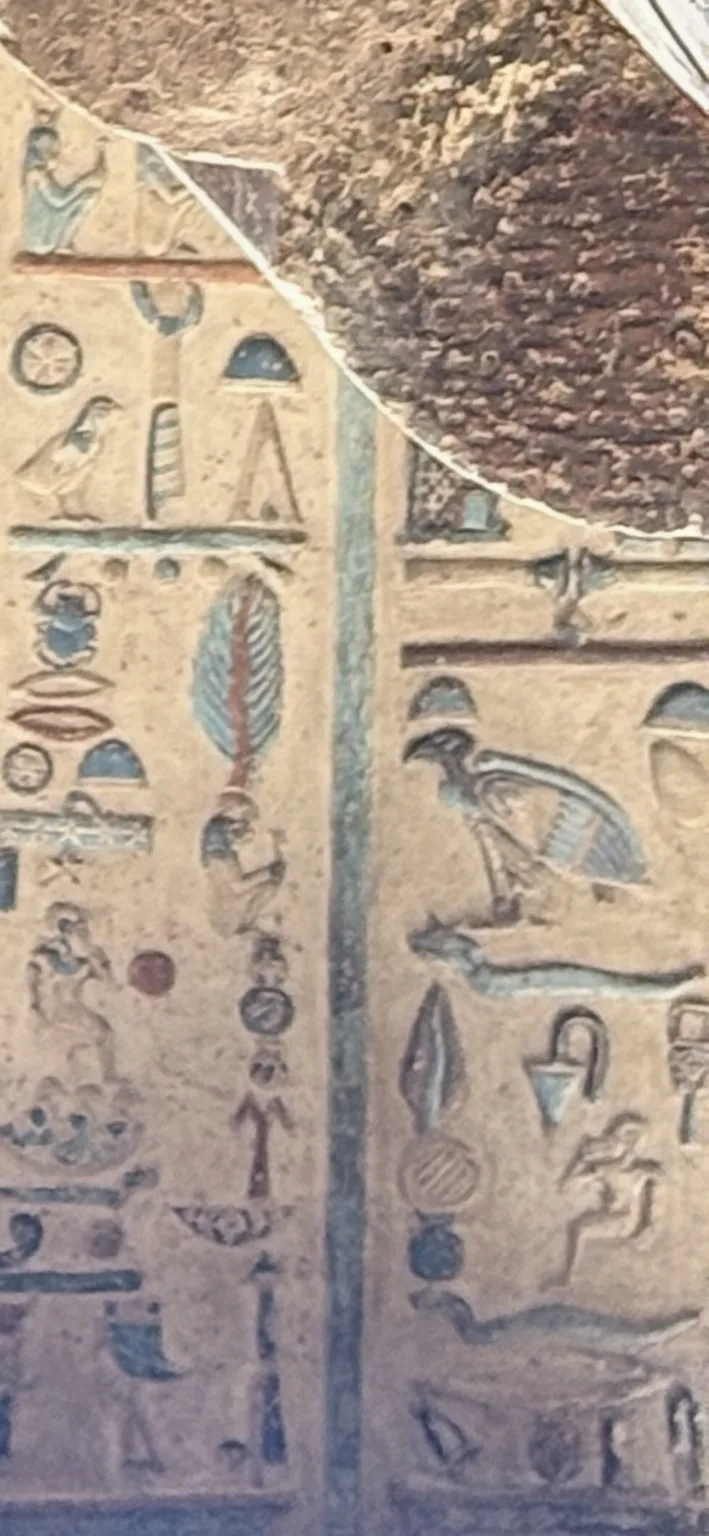
A large bird figure occupies the register above/near a small youthful seated figure; a sistrum-like object appears nearby.
Reading (the site owner, as discussed with Violet)
The site owner's modern visual translation is a divine nursery: Nekhbet as the protective bird ('modern-day stork myth'), Horus as the baby, and Hathor's sistrum suddenly reading as a baby's rattle. Nekhbet is traditionally vulture-form rather than a stork, but the maternal/protective analogy is the point. The sistrum/rattle comparison is especially evocative because both are handheld shaken sound-makers.
Status Uncertain / working inference Reading, not confirmed
15 'Owls on sticks' / Quidditch silhouettes
Observed
Bird forms appear perched upon or directly associated with long vertical staffs/poles.
Reading (the site owner, as discussed with Violet)
The site owner's immediate analogy was 'owls on sticks' and Harry Potter Quidditch. The modern analogy usefully isolates the morphology: bird + long shaft is a repeated composite silhouette. Rather than forcing a deity name from blur, the next step is to compare whether these are bird standards, perched hieroglyphs, astronomical emblems or another ritual object.
Status Uncertain / working inference
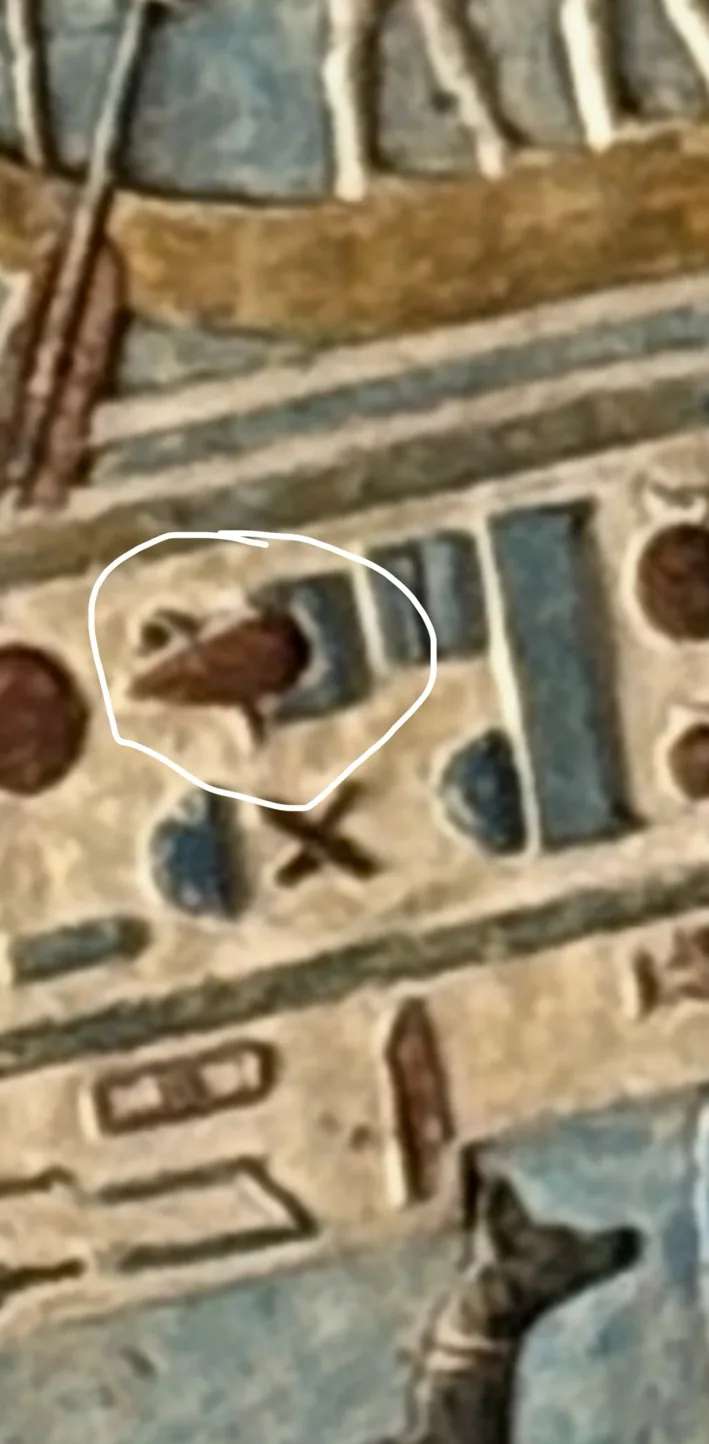
16 Red drop / blue drop – blood and water polarity
Observed
Two closely comparable rounded or teardrop-like forms appear in distinctly different surviving colors: one red-brown and one blue/blue-green.
Reading (the site owner, as discussed with Violet)
The site owner reads them provisionally as a 'blood drop' and 'water drop' or as colored fillers associated with Akhet-like visual material. The chromatic distinction is real in the photographs. A strong working hypothesis is intentional symbolic differentiation: red can participate in blood/fire/solar/vital/danger registers, while blue-green can participate in water, sky, inundation and regeneration. Exact object identity remains open.
Status Uncertain / working inference
17 The 'smiley faces of Dendera'
Observed
Several compact sign groups resolve under magnification into paired rounded/eye-like elements and curved strokes that produce an unmistakable modern smiley-face gestalt.
Reading (the site owner, as discussed with Violet)
The site owner's label is deliberately visual, not a claim that Egyptians carved modern emoji. The value is perceptual: once isolated, these tiny configurations become memorable recurring motifs that can be mapped and compared.
Status Uncertain / working inference
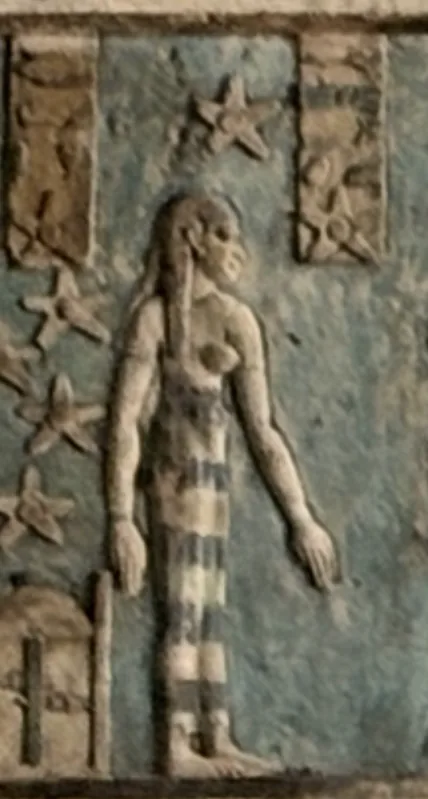
18 #VioletOnTheCeilingLookingFine – solitary star woman
Observed
A frontal female figure stands in a blue celestial field, bare-torsoed with a striped lower garment. Multiple stars cluster around one side and above her.
Reading (the site owner, as discussed with Violet)
The site owner immediately tagged the figure as scry material: '#VioletOnTheCeilingLookingFine.' The serious visual question underneath the joke is excellent: why is this female body isolated so cleanly in celestial blue, and why are the stars distributed asymmetrically around her? Preserve the scrying association first; identify the astronomical figure second.
Status Uncertain / working inference